


Guidelines Calls
Call open · Closes 15 October 2026
Develop a new European guideline.
The European Dermatology Forum invites clinicians and researchers across Europe to lead the next EuroGuiDerm clinical guidelines. This call covers two priority topics where European practice needs a single, evidence-graded reference. You do not need to be an EDF member to apply.
STEP 1 — SELECT YOUR TOPIC
Two priority topics — or your own
Choose the guideline you intend to lead, or propose a subject of your own. The brief below updates to show the clinical need, proposed scope and the expertise your group should bring.
A major update for the JAK-inhibitor era.
Guideline update · up to 15 months
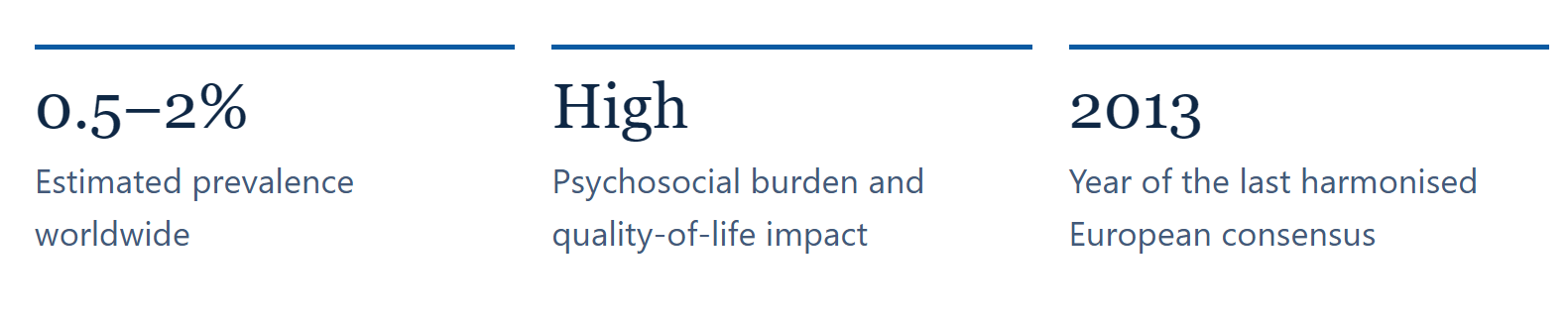
European guidance on vitiligo was last harmonised in 2013. Topical JAK inhibition (ruxolitinib cream, EMA-approved for non-segmental vitiligo in 2023), advances in phototherapy and a growing systemic pipeline have moved well past that consensus. Clinicians need an updated, evidence-graded algorithm for assessment, treatment sequencing and maintenance.
Proposed scope
Classification (segmental vs non-segmental) and disease activity assessment
Validated outcomes — VASI, repigmentation thresholds, patient-reported measures
Topical therapy, including JAK and calcineurin inhibitors
Phototherapy (NB-UVB) and combination regimens
Systemic and emerging therapies
Maintenance, relapse prevention and special sites
Paediatric care, psychological support and shared decision-making
Last official guidance
Taïeb A, Alomar A, Böhm M, et al. Guidelines for the management of vitiligo: the European Dermatology Forum (EDF) consensus. Br J Dermatol. 2013;168:5–19.
Target users: Dermatologists, paediatric dermatologists, GPs with a dermatology interest, patient representatives.
Expertise sought: Pigmentary disorders, phototherapy, paediatric dermatology, methodology, patient advocacy.
Europe's first EuroGuiDerm standard for autoimmune hair loss.
New guideline · up to 24 months
Alopecia areata has no harmonised European guideline, yet the field has changed fundamentally. Baricitinib (2022) and ritlecitinib (2023) are now EMA-approved for severe disease, including adolescents. European dermatology needs one evidence-graded reference covering severity staging, treatment selection, monitoring and the management of relapse.

Proposed scope
Severity assessment and staging (SALT and beyond)
Topical, intralesional and systemic corticosteroid use
Contact immunotherapy for extensive disease
Oral JAK inhibitors — selection, monitoring and stopping rules
Paediatric and adolescent treatment pathways
Relapse and long-term management
Eyebrow, eyelash and nail involvement; psychosocial impact
Last official guidance
Messenger AG, McKillop J, Farrant P, et al. British Association of Dermatologists' guidelines for the management of alopecia areata 2012. Br J Dermatol. 2012;166:916–926.
Propose a subject of your own.
New guideline or update · scope you define
These two topics are this cycle's priorities, but the EDF welcomes proposals on any area of dermatology and venereology where European practice would benefit from a single, evidence-graded reference. You define the subject, the clinical need and the scope; the EDF Guideline Commission assesses it on clinical relevance, methodological rigour, collaboration and feasibility.

Proposed scope
Define the population and the clinical questions (PICO / PIRT)
Set the outcomes that matter, with adverse events included
State what existing guidance exists and what your project adds
Choose the methodology — systematic review, Delphi or adaptation
Propose a multidisciplinary group across at least five countries
Include patient representation and a dissemination plan
Last official guidance
No preset reference for an open subject — cite the current evidence and any existing national or international guidance in your proposal.
The call in brief
At a glance
Who can apply
Eligibility
Open to members of EDF, EADV or affiliated national societies, guideline groups, and individuals or institutions with relevant expertise. Membership is not required.
One proposal as Convenor per call. Convenors may not be voting members of the EDF Guideline Commission.
The topic meets a clear clinical need. No commercial sponsorship.
Build your panel
Guideline group
Propose a complete, multidisciplinary group led by you as Convenor (or joint convenors).
1 Convenor / joint
1 Methodologist
1 Fellow
2 Patient representatives
2 Young investigators
1 Health professional
≤5 Open-call members
Conflicts of interest. All members declare interests from the last five years on submission and keep them updated throughout; declarations are published with the guideline. Members with an interest involving a drug manufacturer are excluded from voting on recommendations concerning that company's drugs.
What to submit
What your proposal covers
One document, in English. Methods and your team matter most. Projects may use systematic review, a Delphi process or adaptation, depending on type.
Proposal, abstract & lay summary
The guideline you propose and its objectives, in full and in plain language.Clinical need
What is already known, what this project adds, and its effect on practice.Methodology
Your review approach, evidence grading and consensus process.Group & declarations
Composition and countries, with a declaration of interest for every member.Timeline & budget
A timeline with milestones and a short, justified budget.Dissemination plan
How the guideline will be published, translated and communicated.
How EuroGuiDerm works
Methodology you commit to
Projects follow the EDF methodology for European dermatology guidelines. Proposals must show how these standards will be applied.
Structured questions
PICO for intervention questions, PIRT for diagnostic. Outcomes ranked 1–9 by importance (GRADE).
Systematic review
Per the Cochrane Handbook: search strategy, risk of bias and evidence tables. A librarian or methodologist is strongly advised.
Consensus & voting
Up to 5 overarching principles and 10–15 recommendations. Consensus is reported as percentage agreement — strong consensus >95%, consensus >75–95% — with >50% the minimum to include a recommendation.
Managed conflicts
All members declare interests from the last five years. Members with an interest involving a drug manufacturer do not vote on recommendations about that company's drugs.
Before submission, the draft guideline is reviewed by EDF members who are specialists in the relevant field.
How proposals are judged
Evaluation criteria
Clinical relevance
Meets a real gap in European practice with clear benefit to patients.
Methodological rigour
A credible review, GRADE grading and a sound consensus plan.
Collaboration
A multidisciplinary group across countries, with patients involved.
Feasibility
A realistic timeline, clear roles and a sensible budget.
After you submit
How proposals are reviewed
Three stages, ending in a decision by the EDF Guideline Commission.
Stage 1
Pre-eligibility
A quick check that the topic is relevant and within scope.
Stage 2
Eligibility
Review for administrative and methodological completeness.
Stage 3
Commission decision
Approval, a request to revise, or rejection by the EDF Guideline Commission.
From idea to submission
How to apply
Assemble your group
Line up your Convenor, methodologist and patient representatives. No EDF membership needed.Draft your proposal
Cover the six parts above, with most attention on methods and your team.Collect declarations
Each proposed member submits a conflict-of-interest declaration.Submit the form
Complete the online application before the deadline.
Ready to lead
Start your
guideline proposal
Complete the online application form — no EDF membership
required. The form produces a structured record of your
proposal.
Submission deadline: 15 October 2026, 23:59 CET · Proposals to guidelines@euroderm.org
This website uses cookies!

We use cookies to tailor our content to your needs and continuously improve our website. You can decide which cookies you want to allow. Detailed information about the cookies we use can be found in our Privacy Policy and Cookie Settings. You can withdraw your consent at any time.